
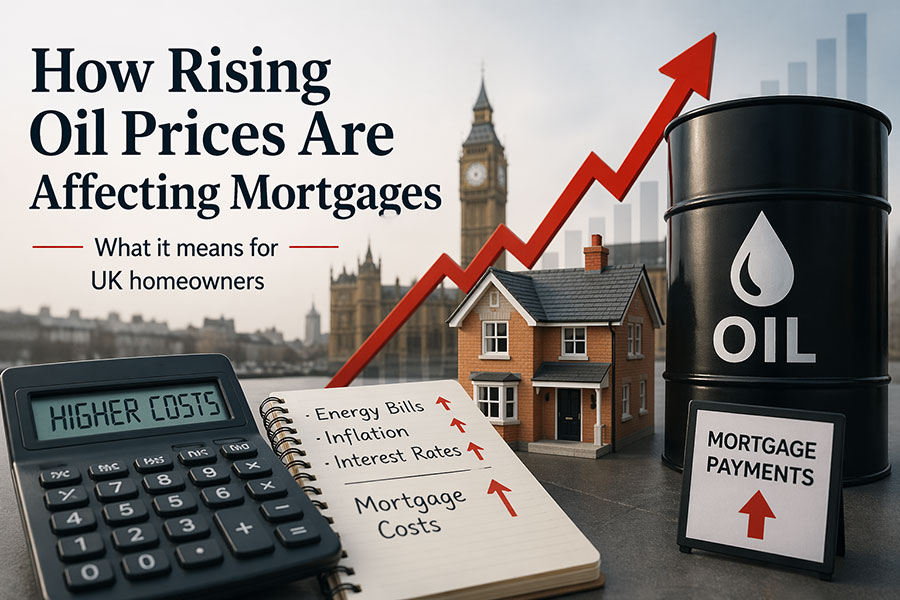
Cast your mind back to January 2026. Most forecasters were expecting the Bank of England to cut interest rates at least twice during the year, and many borrowers were quietly hopeful that the cost of their mortgage would ease before long. Fixed-rate deals had been drifting downward. The worst of the post-pandemic inflation surge felt like it was behind us.
Then, in late February and early March, the situation in the Middle East escalated sharply. Oil and gas prices spiked. The Bank of England, which had been on course to reduce rates further, held them at 3.75% in March — citing the energy shock directly. Fixed mortgage rates, which had been sitting around 4.83% for a two-year deal at the start of March, climbed to around 5.89% within weeks. Major lenders including Barclays and Nationwide pulled their sub-5% products and repriced almost overnight.
For anyone with a mortgage — or planning to get one — this chain of events is not abstract. It translates into real numbers on a monthly statement. This article explains the mechanism clearly, shows what the numbers look like for different borrowers, and sets out what is worth thinking about now.
The link between oil prices and your mortgage
Understanding why oil prices affect mortgage rates requires following a fairly short chain of cause and effect. Once you can see it, the connection becomes intuitive — and you can apply the same logic to future events.
Step one: oil prices rise
The conflict in the Middle East disrupted the production and transportation of oil and gas. The Strait of Hormuz, through which roughly a fifth of the world’s oil supply flows, was severely affected. Wholesale energy prices rose sharply in response.
Step two: inflation goes up
Higher oil and gas prices feed directly into the Consumer Prices Index (CPI). Fuel costs more at the pump. Transport and logistics become more expensive. Businesses face higher input costs and pass some of them on. UK CPI, which had been at 3.0% in January 2026, was projected by the Bank of England to rise to between 3.0% and 3.5% over the following quarters as a direct consequence.
Step three: rate cuts get shelved — or reversed
The Bank of England’s primary mandate is to keep inflation at 2%. When inflation is rising, reducing interest rates would add further stimulus to an already-pressured economy — making the Bank’s job harder, not easier. The March 2026 MPC meeting, which markets had been expecting to deliver a rate cut, instead resulted in a unanimous vote to hold at 3.75%. Traders moved from pricing in cuts to pricing in hikes — as many as two potential increases to 4.25% by year-end.
The National Institute of Economic and Social Research has modelled the scenario directly: if energy costs remain elevated for a full year, they estimate the base rate could be pushed to 4.5%. Oxford Economics, meanwhile, believes the Bank will hold at 3.75% for the rest of 2026 and well into 2027. That is a significant shift from what was expected as recently as February.
Step four: swap rates rise, and fixed mortgage rates follow
Most fixed-rate mortgages are not directly tied to the Bank of England base rate. They are priced off ‘swap rates’ — the rates at which banks and lenders can hedge their future interest rate risk in the financial markets. When markets expect rates to stay higher for longer, or to rise further, swap rates increase. Lenders respond by repricing their fixed-rate products upward, often within days. This is precisely what happened in March and April 2026. Industry commentary at the time made clear that the sharp change in the inflation outlook had already sent mortgage rates substantially higher — with markets now factoring in rate rises that were unthinkable just a few weeks earlier.
Markets moved from pricing in cuts to pricing in hikes within the space of a few weeks — a shift in expectations that fed directly and rapidly into the fixed-rate deals available to borrowers.
What has actually happened to mortgage rates
The scale of the repricing in March and April 2026 is significant. The table below compares average rates before the conflict began with where they stood in April 2026, using Moneyfacts data.
Table 1 — UK average fixed mortgage rates: before and after the oil price shock
| Mortgage type | Average rate (pre-conflict Feb / early March 2026) | Average rate (April 2026) |
| 2-year fixed (all LTVs) | 4.83% | ~5.89% |
| 5-year fixed (all LTVs) | 4.95% | ~5.77% |
| SVR (standard variable) | 7.13% | 7.13%+ |
| Tracker (best buy) | ~4.75% | Tracks base rate — risk of rises |
Source: Moneyfacts industry data, March–April 2026. Average rates across all LTVs. Best available deals will differ by loan-to-value, lender and individual circumstances.
To put those figures in practical terms: a borrower who locked in a two-year fix at the pre-conflict average of 4.83% is paying noticeably less each month than someone taking out the same mortgage today. The table below illustrates the difference across a range of loan sizes, based on a 25-year repayment mortgage.
Table 2 — Monthly repayment comparison: pre-conflict rate (4.83%) vs April 2026 average (5.89%)
| Mortgage balance | At 4.83% (pre-conflict) | At 5.89% (April 2026 avg) | Monthly increase | Annual increase |
| £150,000 | £860/mo | £956/mo | +£96/mo | +£1,152/yr |
| £200,000 | £1,147/mo | £1,274/mo | +£127/mo | +£1,524/yr |
| £250,000 | £1,433/mo | £1,593/mo | +£160/mo | +£1,920/yr |
| £300,000 | £1,720/mo | £1,911/mo | +£191/mo | +£2,292/yr |
| £350,000 | £2,007/mo | £2,230/mo | +£223/mo | +£2,676/yr |
Based on a 25-year capital and interest (repayment) mortgage. Figures calculated using the standard annuity repayment formula and rounded to the nearest pound. Pre-conflict rate of 4.83% and April 2026 average of 5.89% per Moneyfacts industry data. These are illustrative figures based on average rates — the rate available to you will depend on your loan-to-value, credit history and lender. Speak to an adviser for a personalised comparison.
| Important context for remortgagers
Around one million fixed-rate deals are due to expire between April and September 2026, according to the Financial Conduct Authority. Many of those borrowers fixed in 2021 at rates below 3%. Coming off those deals now means moving to today’s rates — a difference that, as the table above shows, can amount to hundreds of pounds per month. Sitting on your lender’s standard variable rate (SVR) while you wait for things to improve is rarely the right answer. The average SVR in April 2026 is 7.13% — considerably higher than even the current elevated fixed-rate market. |
What happens next — and why it is hard to predict
There is genuine disagreement among economists and lenders about where rates go from here. That uncertainty is itself worth understanding, because it affects the decisions available to borrowers.
On one side, those expecting rates to fall point to the underlying UK economic picture: growth is weak, unemployment is at a five-year high, and the Bank of England’s own guidance before the conflict was firmly toward further cuts. If the conflict stabilises or resolves, energy prices could ease relatively quickly, taking inflationary pressure with them. Some forecasters suggest a September 2026 cut remains plausible in that scenario.
On the other side, Goldman Sachs and Citi have both revised their forecasts from three cuts in 2026 to none. ING’s James Smith predicts rates will stay unchanged throughout the year. The NIESR’s modelling suggests that if energy costs remain high for a sustained period, the base rate could reach 4.5%. JP Morgan has gone further, predicting a hike as early as June.
The honest answer is that no one knows how long the conflict will last, and therefore no one can say with confidence whether mortgage rates will be higher or lower in six months than they are today. The practical implication of this uncertainty is that waiting for a ‘better time’ to act carries its own risk.
The honest position, shared by many economists and market commentators, is that predicting the direction of mortgage rates over the coming months has rarely been harder. Those waiting for certainty before acting may find the window has passed.
What this means for you, depending on your situation
The right course of action depends entirely on where you are in your mortgage journey. The table below sets out the key considerations by borrower type.
Table 3 — Your situation and what to consider
| Your situation | What is happening now | What to consider |
| On a tracker or variable rate | Base rate held at 3.75%, but markets now price in possible hikes — not cuts. Your rate could rise with little notice. | Model your repayments at 4.25% and 4.5%. Speak to a broker about whether a fixed rate gives better certainty for your budget. |
| Fixed deal ending in the next 6 months | Lenders repriced upward sharply in March–April 2026. Average 2-year fix is now ~5.89% vs 4.83% before the conflict. | Act now. Many lenders allow you to lock in a new rate up to 6 months in advance. Waiting for a cut that may not come carries real cost. |
| Fixed deal ending in 6–12 months | Swap rates have risen, meaning lenders’ future pricing is uncertain. Rates may ease if the conflict stabilises — or rise further. | Monitor the market regularly. Set a calendar reminder to review 4 months before your deal ends. Speak to a broker early. |
| On an existing long-term fix (2+ years remaining) | You are insulated from current volatility until your deal ends. | No immediate action needed. Use this time to review your wider financial position and plan ahead for your next deal. |
| Buying for the first time or moving | Rates have risen faster than many buyers expected. Affordability calculations are tighter. | Stress-test your budget at 6%+. An independent broker can search the whole market and may find deals not available directly. |
Fixed or tracker — which is right in this environment?
This is the question most borrowers are wrestling with right now, and there is no universal answer. What has changed is the risk calculation.
Before the conflict, tracker mortgages carried a certain logic: if cuts were coming, a tracker would follow them down without early repayment charges. That logic has now reversed. With the market pricing in potential hikes rather than cuts, a tracker exposes you to upward movement with little warning. The ‘best buy’ tracker sits at around 3.96% above Bank Rate today — attractive on paper, but that number moves automatically if the base rate rises.
Fixed rates offer certainty at a cost. The current two-year average of around 5.89% is higher than most borrowers would have hoped for at the start of the year. But a five-year fix at around 5.77% locks your payment for the duration, regardless of what happens in the Middle East, with swap rates, or at the next six MPC meetings. For households that need budgeting certainty — particularly those who have already stretched to afford their home — that predictability has real value.
| A note on ‘waiting it out’ on your SVR
Some borrowers choose to roll onto their lender’s standard variable rate and wait for a better deal to appear. The average SVR in April 2026 is 7.13%. On a £200,000 mortgage over 25 years, that is approximately £1,416 per month — around £275 more per month than even the current elevated average two-year fix. That is over £3,300 per year of unnecessary cost for every year spent on the SVR. Unless you are very close to selling the property or have a specific reason to avoid fixing, the SVR is almost always the most expensive option. |
The longer-term picture
It is easy, in a moment of market disruption, to assume the current situation is permanent. It is not. The UK has navigated significant energy shocks before — the 2021–22 crisis saw wholesale gas prices reach nearly 600p per therm, CPI inflation breach 11%, and the Bank of England raise rates 14 times in succession. Mortgage rates did eventually come down as inflation was brought under control.
The trajectory of rates from here depends primarily on three things: how long the conflict and its effect on energy supply persists, whether second-round inflation effects (businesses raising prices, wage growth accelerating) take hold, and how aggressively the Bank of England responds. None of those are knowable with certainty today.
What borrowers can control is how well-positioned they are for different outcomes. That means understanding exactly what deal they are on, when it ends, what the alternatives look like across the market, and whether their monthly budget can absorb a reasonable range of rate scenarios. A short conversation with a qualified mortgage adviser can answer all of those questions quickly.
| Speak to True Advice Financial Services
Whether your deal is ending soon, you are on a variable rate, or you are simply unsure what the current market means for your mortgage, our advisers can give you a clear, personalised picture. We will compare your options across the market and help you make a decision that is right for your circumstances — not just what the headlines suggest. |
Important Information
This article is for general information purposes only and does not constitute financial advice. All figures are based on publicly available data as at April 2026. Mortgage rates, economic forecasts and base rate predictions are subject to change and may differ from actual outcomes. The rate available to you will depend on your personal circumstances, loan-to-value and lender criteria. Your home may be repossessed if you do not keep up repayments on your mortgage. Always seek advice from a qualified, FCA-regulated mortgage adviser before making any decision. True Advice Financial Services is authorised and regulated by the Financial Conduct Authority.
Sources: Bank of England MPC Minutes, March 2026 (bankofengland.co.uk); Moneyfacts mortgage rate data, March–April 2026; National Institute of Economic and Social Research (NIESR) energy/rate modelling; Financial Conduct Authority mortgage market data; Oxford Economics, Goldman Sachs, Citi, ING and JP Morgan rate forecasts as reported in national financial press, April 2026.

He holds a CeMAP qualification and has been advising since 2018, continually updating his expertise through ongoing training. Ashley's client-focused approach ensures personalized, effective advice, fostering long-term relationships. Outside of work, he enjoys playing football and exploring new countries. For personalized financial advice, Ashley is dedicated to helping clients achieve their goals.
- Will Your Pension Be Subject to Inheritance Tax From 2027? - September 16, 2026
- Mortgage Myths That Could Be Costing You a Home - August 23, 2026
- Crypto, Gold and ISAs: A Straight Look at How Britain Is Investing in 2026 - August 23, 2026